


Ben Tufnell is a writer and curator based in London. He has published widely on modern and contemporary art, in particular on artforms that engage with ideas of landscape and nature. His books include Land Art (Tate Publishing, 2006), On The Very Edge Of The Ocean (Tate St Ives Research Series, 2006), and In Land: Writings Around Land Art and Its Legacies (Zero Books, 2019). A selection of art writings and projects are archived at bentufnell.com
His short stories have been published by Elsewhere: A Journal of Place, The Fiction Desk, Litro, Lunate, Storgy, Structo and The Write Launch, and as chapbooks by Nightjar Press and The Aleph Press. He has been longlisted or highly commended for the BBC Short Story Award (2022), the Sean O’Faolain Short Story Prize (2022), The White Review Short Story Prize (2021) and the Disquiet Fiction Prize (2020). In 2022 he was shortlisted for the Society of Authors’ ALCS Tom-Gallon Trust Award for short fiction. His debut novel, The North Shore, is a work of gothic literary fiction, published by Little Brown in 2023. Paradise, his second novel, is published by Influx Press in March 2026, to be followed by a collection of short stories.
Instagram: @ben_tufnell
‘A queer, oneiric, watery fable in which narrative form and logic are in constant flux. […] A captivating torrent of myth and grotesquery.’ – Times Literary Supplement
‘A haunting evocation of place told by those who rightly love and fear it. An enticing, wrack-like tangle of myth, mystery and the power of the sea and its stories.’ – Kiran Millwood Hargrave
‘Brilliant: singular, unsettling and mutative . . . combining the mythical and the grotesque with sublime writing and an intense fascination with the natural world.’ – Rosie Andrews
‘That rare beast, a work of folk horror that holds its own with the classics whilst exhibiting genuine points of difference, a radical literary sensibility combined with an old-fashioned appetite for the strange.’ – Nina Allan
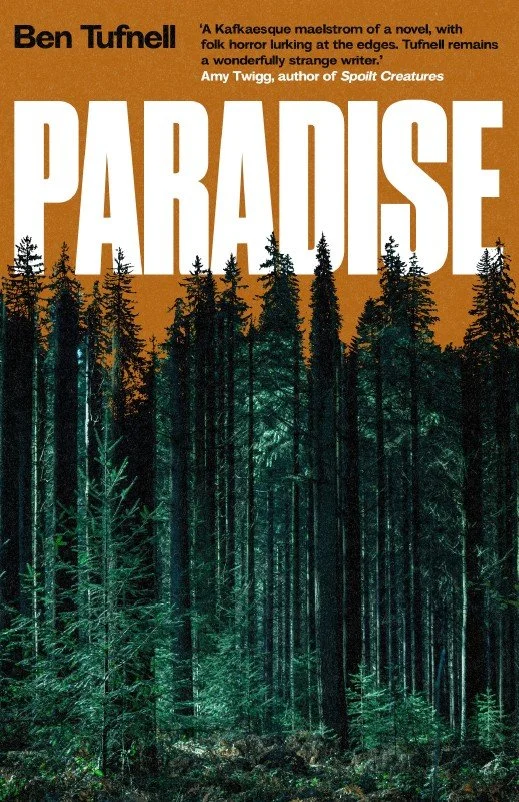
‘A Kafakaesque maelstrom of a novel, with folk horror lurking at the edges. Tufnell remains a wonderfully strange writer.’ – Amy Twigg
‘A powerful novel of psychogeography set between two landscapes, urban and rural, in a world palpably on the brink of collapse. Febrile with paranoia and alienation, Paradise confronts the crucial, intimate matter of our time: how ‘to be’ at the end of all things.’ – Charlotte Tierney
'Paradise is a compelling fusion of literary noir with eco-fable – page turning and profound, I loved this book, Tufnell is a tour de force of imaginative power.' – James Miller